MCP Hub & Integrations
An MCP marketplace agents plug into on demand — ticketing, comms, docs, CI/CD, monitoring & design — with heavily-used servers promoted to native CLIs for lower token cost.
automatedev.ai is the agentic OS for software engineering. One idea goes in — a tested, reviewed, merged pull request comes out. It plans, builds, tests, reviews and secures your software on its own, with the engineer in control at every gate.
The live pipeline
The OS owns the entire loop. Every phase has explicit success criteria, runs in isolation, and is observable end-to-end — control flow lives in code, never a fragile prompt-chain.
Your idea and files become a clear, written brief.
A short back-and-forth writes and locks the plan at a gate.
An isolated run per repo — own workspace & database.
Tested end to end, reviewed, and scanned for security — findings loop back as fixes.
A finished change as one pull request, authored as you.
Plugs into your stack
Your AI engine of choice, GitHub & GitLab, Vault for secrets, Playwright, Postgres & Docker — wired today, with more on the roadmap.
The actual product
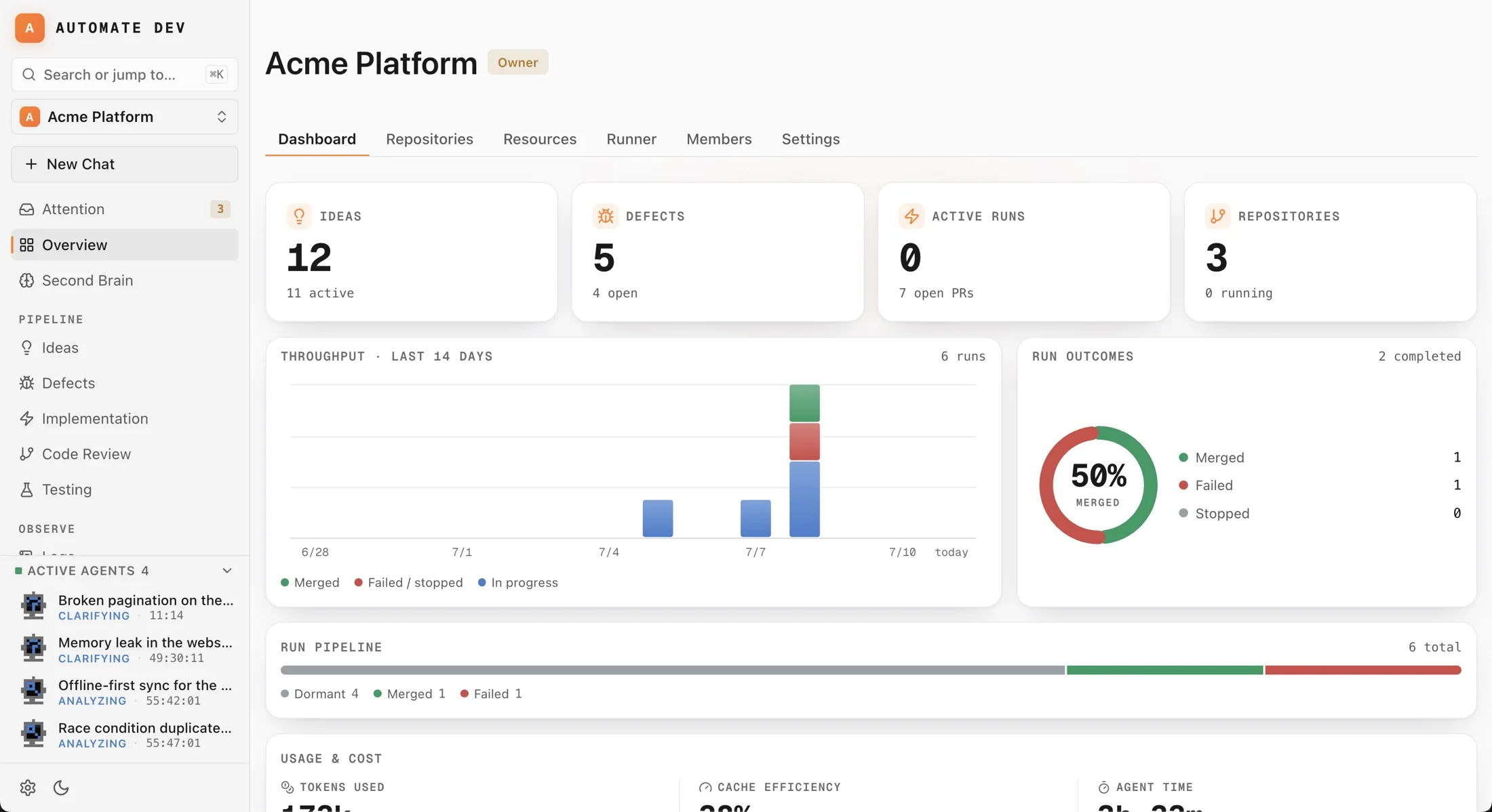
Not a concept render — the real self-hosted control plane. Ideas, defects, implementation, review and testing live in one place — each an autonomous run you can watch and gate.


From idea intake to autonomous debugging, every capability runs on the same deterministic control plane — a shared brain, isolated runs, and a human gate only when judgment is needed.
Approve the plan and a single session drives implement → test → review → secure → PR across every repo — retrying build, test and git failures on its own, and resuming mid-pipeline after any restart.
Each run gets its own workspace, network sandbox and throwaway database — so many versions of the same app run at once, on the same ports, with zero collisions.
A fresh agent drives the running app through acceptance scenarios and attaches screenshot proof. Pass opens the PR; fail re-implements with the failure in hand.
An autonomous reviewer checks correctness, style and reuse; a dedicated security pass scans for injection, access and secret-handling flaws — every finding routes back into the fix loop.
Claude Code, Copilot, Codex and more install on demand behind one factory — or bring your own API key. Swap the engine without touching the pipeline.
A live stream of the agent’s text, thinking, tool calls and file diffs — with allow, always-allow or reject on any action, and a stop button that halts a run mid-flight.
Shared knowledge
Built from your own code and docs and kept current — a map of how everything fits together, across every repo and team.
Why things were built the way they were is captured and kept. Every shipped feature enters the memory — one source of truth.
The right context is handed to each run up front, so agents work from what’s already known instead of re-reading everything.
Hosted SaaS, desktop & web apps for instant adoption.
Source & secrets never leave your network.
Runs anywhere
Regulated and IP-sensitive teams can't send source to a third party — so they run automatedev entirely inside their network. Same OS, same loop, zero data exit. It's the thing cloud-only rivals can't offer, and the reason enterprise pays.
Control flow lives in code — an event bus, workflow engine & gate manager that outlast any single model.
From idea to shipped PR, the OS owns the engineering workflow around the code — not just the typing.
These capabilities aren't shipped yet — here's where automatedev is heading next. Everything above runs today; everything below is planned.
An MCP marketplace agents plug into on demand — ticketing, comms, docs, CI/CD, monitoring & design — with heavily-used servers promoted to native CLIs for lower token cost.
Mobile apps build in the same pipeline, with Appium & device test CLIs mirroring the Playwright tester — end-to-end automation that extends to mobile, not just web.
Continuous log & APM monitoring across dev and production that auto-detects incidents, builds a reproduce pack, then fixes, tests & opens a PR — closing the loop from live failures.
A stakeholder PRD step for business & PM users, brain-informed about code intricacies, UI themes & constraints — flagging the docs, APIs & approvals a feature needs up front.
Chat to build a workflow, generated from your plan & prompts. Tag it to an agent and a trigger point, then run it on a schedule or an event.
A pure offline, signed license key for air-gapped self-hosted deployments — entitlement enforced without ever phoning home.
Planned integrations
Two ways to adopt the same platform. Talk to us and we’ll scope the right one for your team.
What automatedev.ai is, how it runs, and how it stays under your control.
It is a control plane that runs AI coding agents through the full engineering job — not just autocomplete. You give automatedev.ai an idea, a defect, or a ticket, and it plans, writes, tests, reviews, and secures the change as one autonomous run, ending in a merged pull request. A human engineer approves at every gate.
Yes. automatedev.ai is self-hosted and single-tenant: one deployment per client, running entirely on the client's own infrastructure. Your source code never leaves your network, so there is zero data exit. A hosted cloud option is also available for teams that prefer not to run their own infrastructure.
automatedev.ai uses a vendor-neutral provider factory. Claude Code is the reference and default engine. GitHub Copilot, Codex, Opencode, Antigravity, and Kimi install on demand, and you can bring your own API key. You can swap the underlying engine without changing the pipeline.
Every run streams the agent's text, thinking, tool calls, and file diffs live. You can allow, always-allow, or reject any action, and a stop button halts the run instantly. Autonomy is gated at checkpoints — the PRD, the plan, and pre-merge or release — so nothing ships without human approval.
It integrates with GitHub for source control and Jira for ticketing. Secrets use a pluggable provider with a HashiCorp Vault adapter and a built-in encrypted store. Every integration sits behind a swappable adapter interface.
Pricing is quote-based with two ways to adopt the same platform: Teams · Cloud, hosted by automatedev.ai, and Enterprise · In your walls, fully self-hosted and single-tenant. Contact hello@automatedev.ai to scope the right option for your team.
Feature development, debugging, review and refactor, and release are all first-class workflows. An onboarding workflow maps your codebase first so the others run with full context.
Copilot and Cursor accelerate the keystroke — they help an engineer write code faster in the editor. automatedev.ai owns the whole job: it runs the plan-build-test-review-secure pipeline autonomously and returns a reviewed, tested, merged pull request. It is self-hosted and single-tenant, and it orchestrates coding agents rather than being one.
Book a 30-minute demo and watch a real run go from brief to reviewed, tested, merged pull request — in the cloud or entirely inside your own walls.